

Are you still worried about Microsoft AB-620? I advise you to google "Prep4cram". We provide you AB-620 free demo download for your reference. AB-620 Prep & test bundle is very useful and similar with the real exams. If you are willing to pass exam at first shot you had better purchase exam cram, we will send you the exam cram PDF file. It is very available for reading at all electronics and printing out. The most important is that we guarantee: "No Pass, No Pay". We already help more than 3000 candidates pass this exam. We are proud to say that about passing AB-620 we are the best.
Up-to-date Version, Latest, Valid
We promise AB-620 exam cram all we sold is the latest and valid version. If you have doubt about it, you can contact with us. Also you can compare our version with the other. Normally if it is not the latest version we won't say 100% pass rate, we will say 70%-80% pass rate and advise you waiting the updated version. We hereby specially certify that the AB-620 exam cram we say 100% pass is the latest and valid version. Do not hesitate about it, just buy it
Our Golden Service
Firstly we are 7*24 on-line services, once you contact with us we will reply you in two hours;
Secondly we have one-year warranty service since you buy. We will send you the updated AB-620 exam version within one year if you accept. No matter you have any question you can email us to solve it.
Thirdly we will keep your information safe. Even our service customers can't see your complete information. We have a strict information protection system.
Fourthly we guarantee AB-620 exam 100% pass rate if you study our AB-620 prep material hard. But if you fail the exam please provide the unqualified certification scanned and email to us. Once we confirm it we will full refund to you.
Fifthly if you buy AB-620 exam cram for your company and want to get the latest version in next several years we are free to serve you in one year and you can give 50% discount AB-620 Prep & test bundle in next year. Also after you buy you will have priority to get our holiday discount or sale coupon. If you pass AB-620 exam and want to buy other subject we can give you discount too.
All in all we have confidence about AB-620 exam that we are the best. If you want to pass it successfully please choose our AB-620 exam cram pdf. You will be happy about your choice. It's certainly worth it.
The Strength & Power of Our Company
We have a lot of experienced education staff from Microsoft who are ngaged in IT certification examination more than 8 years. They are familiar with past AB-620 real exam questions and they know update information about the AB-620 exam at first time. Our AB-620 Prep & test bundle or exam cram pdf are shown on the website with the latest version. Our IT staff will check the update every day.

Microsoft AB-620 Exam Syllabus Topics:
| Section | Weight | Objectives |
|---|---|---|
| Topic 1: Build and extend agents in Copilot Studio | 40–45% | - Develop agent flows and logic
|
| Topic 2: Test, deploy, and manage agents | 20–25% | - Deploy and manage agent lifecycle
|
| Topic 3: Plan and configure agent solutions | 30–35% | - Plan an agent solution
|
Microsoft Designing and Building Integrated AI Agent Solutions in Copilot Studio Sample Questions:
An agent in Copilot Studio is evaluated using a fixed test set and an automated evaluation method.
After running the evaluation, the team observes that the same three interactions fail in every run, while all other interactions pass consistently.
You need to use the evaluation results to determine an accurate conclusion.
What should you conclude from the evaluation results?
- A. The agent should not be deployed.
- B. The outcomes isolate which portions of the agent's functional scope require remediation.
- C. The agent's overall design is flawed and requires a full redesign.
- D. The failing interactions are caused by an issue in the underlying language model.
Correct Answer: B 🗳️
Drag and Drop Question
You are configuring an agent in Copilot Studio for an organization. The organization uses Microsoft Dataverse, Dynamics 365, and SharePoint Online.
The agent must retrieve information from enterprise systems and internal documents. The agent must meet the following requirements:
- Must retrieve the current balance of a customer account stored in
Dataverse.
- Must retrieve the real-time shipping status of an order that updates
throughout the day in Dynamics 365.
- Must answer questions based on the content of a static PDF policy
document.
- Must provide a welcome message that does NOT depend on enterprise
data.
You need to configure the agent to meet the requirements.
How should the agent retrieve the data? To answer, move the appropriate solutions to the correct requirements. You may use each solution once, more than once, or not at all. You may need to move the split bar between panes or scroll to view content.
NOTE: Each correct selection is worth one point.
Correct Answer:
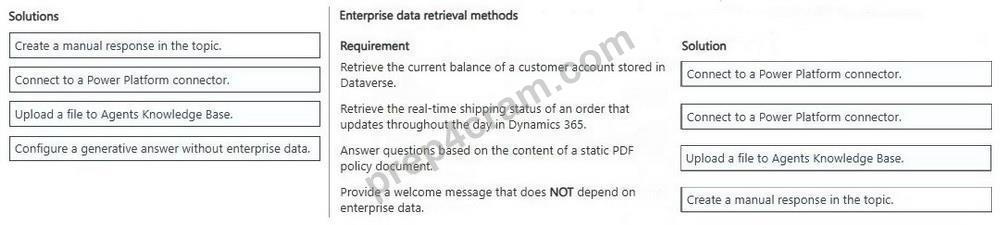
Explanation:
Box 1: Connect to a Power Platform connector
To enable your Copilot agent to fetch specific, real-time structured data (such as a customer's current balance) directly from Dataverse or Dynamics 365, you should connect to a Power Platform connector (or use native Dataverse plugins/tools).
Box 2: Connect to a Power Platform connector
Real-Time Data Access: Dynamics 365 data resides in Microsoft Dataverse. Power Platform connectors (like the Dataverse connector) fetch data live from the source, ensuring the shipping status is perfectly accurate and updated throughout the day.
Box 3: Upload a file to Agents Knowledge Base.
Box 4: Create a manual response in the topic.
Reference:
https://learn.microsoft.com/en-us/microsoft-copilot-studio/knowledge-copilot-studio
https://www.matthewdevaney.com/copilot-studio-change-the-agent-welcome-message/
Case Study 2 - Fabrikam Inc.
Background
Fabrikam Inc. is a Canada-based manufacturer with a growing service organization that supports field technicians and internal operations teams. Fabrikam Inc. plans to launch a new internal agent solution named Operations Concierge to reduce time spent searching policy content, retrieving operational metrics, and executing routine transactions.
The agent will be used by three groups:
- Service coordinators who triage incoming service requests
- Field technicians who need guided procedures and parts availability
- Operations managers who monitor KPIs and exceptions
The agent solution must work in real-world operational conditions. Users often ask questions mid- call with a customer or while coordinating parts shipments. The agents require quick, reliable outcomes. As a result, Fabrikam Inc. requires the solution to:
- Provide grounded answers with traceability when it provides guidance.
- Retrieve real-time metrics when users ask for operational status.
- Execute authenticated updates when users initiate a flow (such as creating a parts request).
Fabrikam Inc. also expects the solution to be maintained by multiple makers and developers across the year. The company has experienced duplicated logic and inconsistent behavior across different agents. This project emphasizes reuse, governance, and maintainability across teams.
Current environment
Fabrikam Inc. runs three Microsoft Power Platform environments for agent development and release: Dev, Test, and Prod.
The team plans to build the agent and validate it in Dev and Test, then promote to Prod by using a controlled release process that supports repeatable deployments.
Fabrikam Inc. already has two assets the team wants to reuse:
- A partially completed Copilot Studio agent named Service Desk Agent, used by IT to create internal tickets and route requests
- A Microsoft Foundry agent created by a central AI team that performs specialized summarization and classification for long-form text (for example, summarizing call transcripts into an incident narrative) Fabrikam Inc. also has operational and knowledge data sources:
- A curated policy library (internal SOPs, service warranty rules, escalation criteria, and standard operating procedures)
- A set of indexed documents and procedures in an Azure AI Search service that supports vector search for the policy library
- A Microsoft Fabric workspace that includes a semantic model used by operations leadership for reporting Business requirements Fabrikam Inc. requires Operations Concierge to meet the following business requirements:
- Traceability requirement: When the agent provides policy guidance or procedural recommendations, users must be able to see where the answer came from.
- Metrics requirement: When users ask about service performance (backlog, SLA risk, parts shortages, dispatch delays), the solution must return up-to-date metrics in a structured format that operations managers can use in weekly reviews.
- Transaction requirement: The solution must support authenticated updates initiated during conversations, including creating a parts request and updating a service case status.
In addition, Fabrikam Inc. wants to avoid duplicating common assets across agents:
- The team must reuse the same set of escalation topics, MCP tool definitions, and a standard safety disclaimer across three different agents.
- Only the platform engineering group as allowed to edit shared assets. However, all agent authors must be able to use them.
Technical requirements
The Fabrikam Inc. solution architecture uses a multi-agent approach so that specialist responsibilities are isolated and can evolve independently.
The Operations Concierge (primary agent) must coordinate the following specialist capabilities:
- Policy and procedure Q&A: Use an enterprise knowledge source that supports indexed retrieval across the curated policy library and service procedures.
- Operational metrics: Delegate metric queries to a Fabric Data Agent that reads governed business data through the Fabric semantic model.
- Authenticated updates: Use tools exposed by an existing internal Model Context Protocol (MCP) server that provides transactional operations for the service organization.
- Specialized processing: Delegate summarization and classification requests to an existing Microsoft Foundry agent.
Fabrikam Inc. will onboard two MCP servers as tools:
- PartsOps MCP server: exposes tools for parts availability checks and parts request creation.
The server requires per-user authentication because actions must be traceable to the requesting user.
- WarrantyRules MCP server: exposes a read-only tool for validating warranty coverage. The server uses an API key shared by the agent team.
Fabrikam Inc. has also defined a collaboration requirement with the existing Service Desk Agent:
- The primary agent must delegate IT-specific requests to the existing Service Desk Agent rather than reimplement ticket creation logic.
Finally, Fabrikarn Inc. plans to support a partner integration:
- For shipment tracking inquiries, Fabrikam Inc. will delegate to a partner-provided agent that is only available through a standardized agent-to-agent endpoint.
Issues and constraints
During early testing, Fabrikam Inc. found three recurring problems:
- Makers are copying and modifying the same components across agents, resulting in inconsistent disclaimers and duplicated tools.
- Users can obtain a correct answer, but the response is not consistently traceable to a source when the agent uses knowledge.
- The primary agent can route some requests, but specialist capabilities are not consistently delegated (for example, some metric questions are answered generatively instead of being routed to the Fabric Data Agent).
You are part of the engineering team responsible for correcting the design and configuration to meet the preceding requirements and constraints.
Drag and Drop Question
You need to connect Operations Concierge to Fabrikam Inc.'s Azure AI Search knowledge index while complying with security requirements.
Which configuration should you use for each requirement? To answer, move the appropriate configurations to the correct requirements. You may use each configuration once, more than once, or not at all. You may need to move the split bar between panes or scroll to view content.
NOTE: Each correct selection is worth one point.
Correct Answer:

Explanation:
Box 1: Select the service principal as the authentication type
When Copilot Studio connects to Azure AI Search, you choose an authentication type for the connection. Copilot Studio supports adding Azure AI Search as a knowledge source, and by default this is set up using key-based authentication. However, keys are shared secrets with no identity tied to them - they don't satisfy governance requirements around authenticated, auditable access. A service principal (Microsoft Entra ID app registration) is different: a service principal is an identity that represents an application and allows it to access resources in your tenant, and for security and compliance reasons, Copilot Studio uses federated identity. Using a service principal means the connection authenticates as a distinct Entra ID identity with role- based permissions (e.g., "Search Index Data Reader") rather than a static key - which is what
"governance requirement for authenticated access" is pointing at.
Box 2: Enter the name of the Azure AI Search index
An Azure AI Search service can host multiple indexes. Simply pointing at the service isn't enough
- Copilot Studio supports vectorized indexes using integrated vectorization, and when setting up the knowledge source you must select/name the specific index that contains your curated content (e.g., the "policy and procedure Q&A" index) rather than some other index that might live on the same service.
Box 3: Provide the Azure Search Endpoint URL in the connection details
The Endpoint URL (e.g., https://<search-service-name>.search.windows.net) identifies which Azure AI Search service instance the connection points to - this is how Copilot Studio knows which physical resource holds your indexed policy documents, as distinct from any other Search service in the tenant.
Reference:
https://learn.microsoft.com/en-us/microsoft-copilot-studio/security-faq
https://learn.microsoft.com/en-us/microsoft-copilot-studio/knowledge-azure-ai-search
Drag and Drop Question
A company plans to use Copilot connectors to ground answers from a third-party system for an agent in Copilot Studio.
To meet the business needs, responsibilities for configuring and using Copilot connectors must be separated, based on the following requirements:
- For tenant administration, the connector must be available at the
tenant level.
- For agent runtime behavior, answers must be grounded from authorized
sources.
- For builder configuration, you must add the connector to the agent.
You need to determine how Copilot connector set-up responsibilities are handled across tenant, runtime, and builder stages.
What should you configure for each requirement? To answer, move the appropriate configuration to the correct requirements. You may use each configuration once, more than once, or not at all.
You may need to move the split bar between panes or scroll to view content.
NOTE: Each correct selection is worth one point.
Correct Answer:

Explanation:
Box 1: Configure the Copilot connector in Microsoft 365 Admin Center
Microsoft 365 Copilot connectors (Graph connectors) must be enabled, authenticated, and configured centrally at the tenant level via the Microsoft 365 Admin Center (Copilot > Connectors). This establishes organizational data availability, schema mapping, and access permissions across the whole tenant.
Box 2: Call the connector knowledge source.
When an end user interacts with the agent at runtime, the execution engine dynamically queries and calls the connector knowledge source to retrieve authorized context and ground the generated response.
Box 3: Add the Copilot connector as a knowledge source.
Maker/builder actions in Copilot Studio involve authoring the agent by choosing to add the Copilot connector as a knowledge source so the agent knows where to retrieve enterprise information from.
Reference:
https://learn.microsoft.com/en-us/microsoft-365/copilot/connectors/overview
https://learn.microsoft.com/en-us/microsoft-365/copilot/connectors/manage-connector
https://learn.microsoft.com/en-us/microsoft-365/copilot/extensibility/agent-builder-add-knowledge
https://learn.microsoft.com/en-us/microsoft-copilot-studio/copilot-connectors-in-copilot-studio
Drag and Drop Question
A company is integrating an agent in Copilot Studio into a custom application by using the Microsoft 365 Agents SDK.
The project requirements specify that the deployment workflow must follow a strict dependency- driven sequence.
- The agent must be published before configuration values are
retrieved.
- End-to-end validation must occur before production deployment.
You need to plan the deployment workflow to integrate the agent.
Which four actions should you perform in sequence? To answer, move the appropriate actions from the list of actions to the answer area and arrange them in the correct order.
Correct Answer:

Explanation:
The four steps that should be used to satisfy the strict dependency-driven sequence, in the correct order, are:
Step 1: Publish the agent
Step 2: Retrieve the current agent configuration values
Must happen after publishing per requirement 1.
Step 3: Implement the Microsoft 365 Agents SDK in the custom app by using the retrieved configuration Requires the configuration values retrieved in the previous step.
Step 4: Validate the end-to-end conversation workflow in a test environment Must occur after application implementation and before production deployment per requirement 2.
Viewing page 1 out of 27 pages.
Viewing questions 1-5 out of 133 questions.


